Beyond C — Amalaki · The Fruit That Rewrites What You Know About Vitamin C

Price range: $25.00 through $50.00

Amla. Indian Gooseberry. The Mother of Ayurvedic Superfoods. One of the Most Researched Fruits on Earth.

Everyone thinks they understand Vitamin C.

An orange. A supplement tablet. Something you take when you feel a cold coming on. Something the body needs but can’t store, so you top it up and move on.
Amalaki — the Indian gooseberry, known in Ayurveda as Amalaki or Amla — is about to change that understanding completely.

Yes, Amalaki is extraordinarily high in Vitamin C. But the name Beyond C was chosen deliberately — because the Vitamin C story, extraordinary as it is, is only the beginning. Modern science has now spent decades investigating this ancient fruit, and what it has found is a compound of such remarkable, far-reaching therapeutic depth that the research community cannot quite keep up with it. Anti-ageing. Cardioprotective. Neuroprotective. Nephroprotective. DNA-repairing. Anti-carcinogenic. Immunomodulating. Anti-diabetic. Anti-inflammatory.

The ancient Ayurvedic sages called Amalaki the Mother and the Nurse — the fruit that nourishes and protects all of life’s stages. Modern science is now discovering exactly why. And behind that discovery lies something the Medicine Man wants you to understand — because it explains why whole-food Amalaki in its natural form is so much more valuable than anything a laboratory could synthesise from it.
This is not a supplement. This is a food. The whole fruit. The way nature made it. The way Ayurveda has always used it.
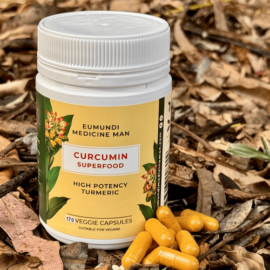
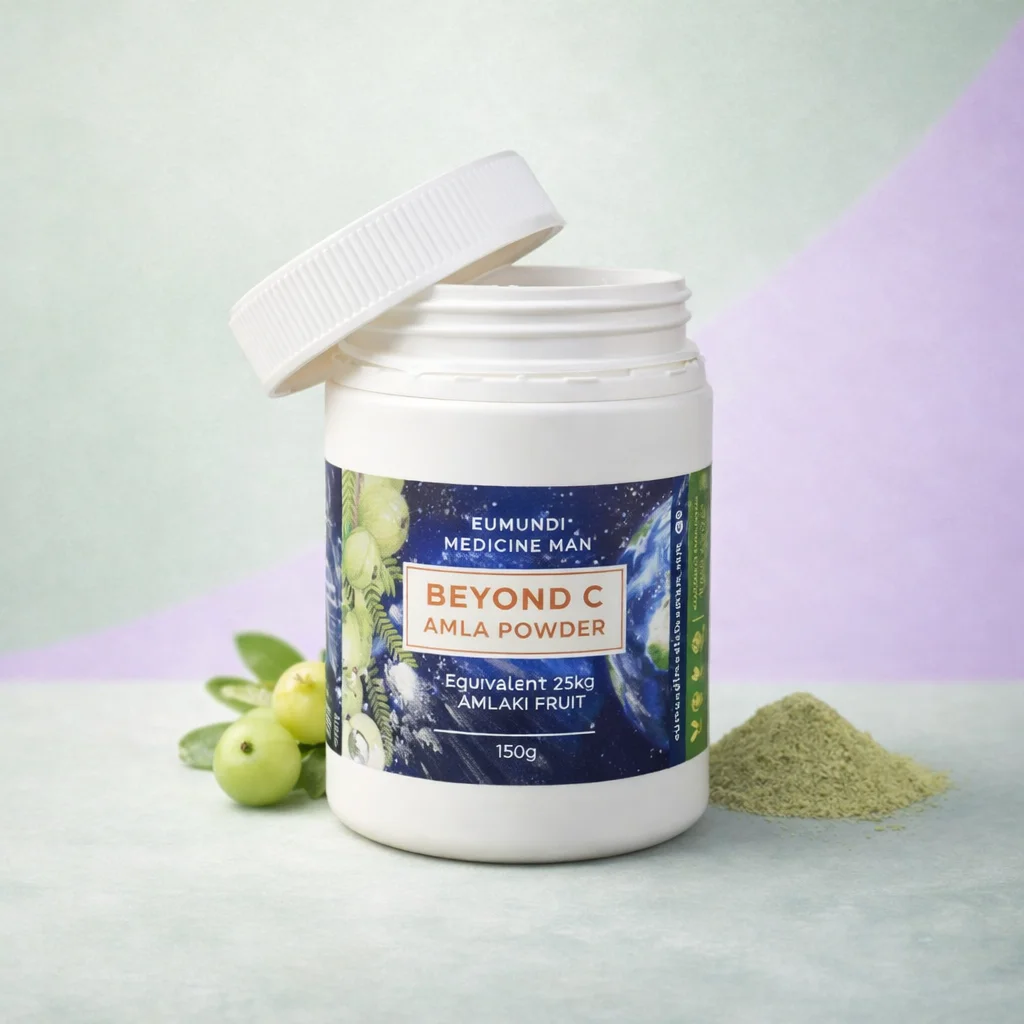
Available in 150g Powder Tub or 60 Veggie Capsules.

Description

Chyavanprash Ayurvedic Tonic

The Truth About Vitamin C — Why Amalaki Goes Beyond

The Vitamin C found in conventional supplements is ascorbic acid — a single isolated compound, synthesised in a laboratory, stripped of every co-factor that makes Vitamin C work in nature. Your body recognises ascorbic acid. It can use it to a degree. But it is to whole-food Vitamin C what a single brick is to a cathedral.

In Amalaki, Vitamin C exists within a complex matrix of naturally occurring co-factors — including Gluco-gallin, Gallic Acid, Ellagic Acid, flavonoids, tannins, and polyphenols — that dramatically enhance its bioavailability, stability, and therapeutic activity. These co-factors do not simply accompany the Vitamin C. They amplify it, protect it from oxidation, direct it to the tissues that need it most, and contribute their own extraordinary therapeutic properties independently.

This is precisely what the pharmaceutical industry is now scrambling to understand — because the research on Amalaki is so compelling that the interest in isolating, patenting, and synthesising its individual components is enormous. They want to take what nature perfected over millennia and sell you a fraction of it in a capsule at ten times the price.

You can simply take the whole fruit. As Ayurveda always has.

What the Science Shows

The research on Amalaki is among the most extensive of any single botanical in existence. A landmark review published in the Journal of Pharmacognosy and Phytochemistry documents a range of properties that span virtually every major system in the body. This is not fringe research. This is peer-reviewed science confirming what Ayurvedic physicians have known for thousands of years.
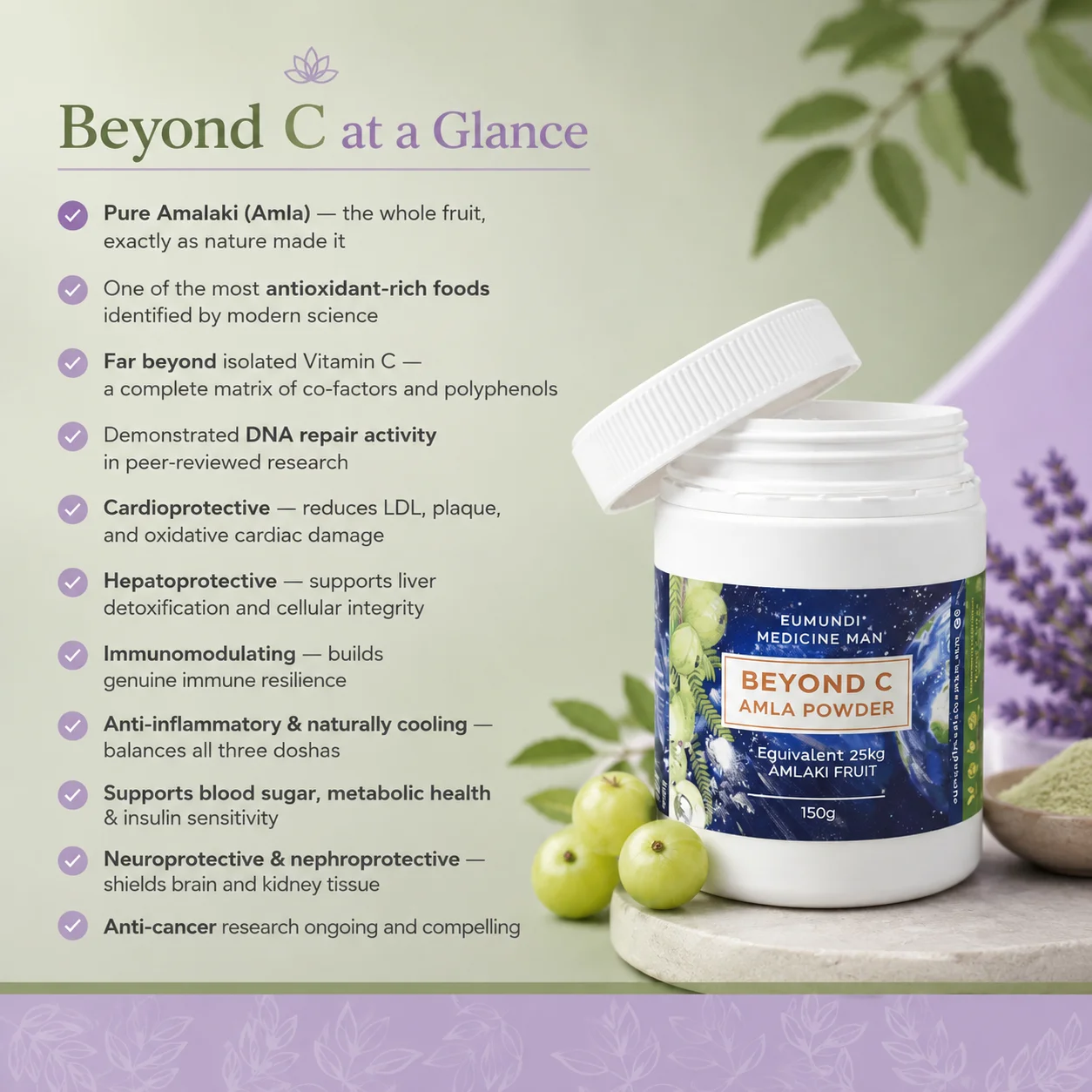
Immune Modulation & Antioxidant Protection Amalaki is one of the most potent natural antioxidants identified in modern research — significantly more potent, gram for gram, than isolated ascorbic acid. Its antioxidant compounds neutralise free radicals, protect cells from oxidative stress, and modulate the immune response in ways that support both defence against acute illness and long-term protection against chronic disease.
DNA Repair One of the most remarkable findings in Amalaki research is its demonstrated capacity to support DNA repair. A study published in the Journal of Ethnopharmacology identified compounds in Amalaki that actively support the body’s own DNA repair mechanisms — with profound implications for ageing, cancer prevention, and cellular resilience. This is not a theoretical benefit. It has been observed and documented in peer-reviewed research.
Cardiovascular Protection Amalaki demonstrates powerful cardioprotective properties — reducing LDL cholesterol and arterial plaque formation (hypolipidemic activity), supporting healthy blood vessel function, and reducing the oxidative damage to cardiac tissue that underlies the progression of cardiovascular disease. For anyone concerned about heart health, Amalaki is one of the most evidence-supported natural interventions available.
Liver & Digestive Health Hepatoprotective — protecting and supporting liver function — is one of Amalaki’s most consistent properties across the research literature. The liver is the body’s primary detoxification organ, and Amalaki supports its capacity to clear toxins, metabolise hormones, and maintain the cellular integrity on which all detoxification depends. It also supports the digestive tract directly, easing gastric ulceration, reducing intestinal inflammation, and improving overall gut function.
Anti-Inflammatory & Cooling In Ayurveda, Amalaki is considered naturally cooling — one of the rare sour substances that reduces rather than aggravates Pitta. This anti-inflammatory, anti-pyretic quality is supported by modern research, which has identified specific compounds responsible for Amalaki’s ability to reduce inflammatory markers across multiple pathways simultaneously.
Blood Sugar & Metabolic Health Research published on NCBI demonstrates Amalaki’s anti-diabetic properties — supporting healthy insulin sensitivity, reducing post-meal blood sugar spikes, and protecting pancreatic cells from oxidative damage. For anyone managing blood sugar, metabolic syndrome, or the path toward type 2 diabetes, Amalaki is a deeply intelligent daily food.
Eye Health Amalaki has been used in Ayurvedic practice for eye health since antiquity — and research now supports this traditional use, identifying protective effects against oxidative damage to ocular tissue. In an age of screens, artificial lighting, and chronic digital eye strain, this is a benefit of growing relevance.
Neuroprotective & Nephroprotective Amalaki demonstrates protective activity in both neural and kidney tissue — reducing oxidative damage, supporting cellular repair, and mitigating the inflammatory processes that drive degeneration in both systems. One study specifically identified protective effects against arsenic poisoning — a striking demonstration of Amalaki’s capacity to shield the body against toxic environmental burden.
Anti-Cancer Properties The research on Amalaki’s relationship to carcinogenesis is among the most intriguing in the entire literature. Multiple studies have investigated its ability to inhibit tumour growth, induce apoptosis (programmed cell death) in cancer cells, and protect healthy tissue from chemotherapy-induced damage. This is not a claim that Amalaki cures cancer — it is an acknowledgement that the science is significant, ongoing, and worth knowing about.

The Ayurvedic Perspective — The Mother of All Fruits

In the Charaka Samhita — one of Ayurveda’s foundational texts — Amalaki is described as the single most important of all rasayana herbs. A rasayana is a rejuvenating substance that rebuilds vitality, slows ageing, and enhances the fundamental life force of the body. Amalaki was placed at the top of this category not for one property but for the totality of its action — nourishing every tissue in the body, balancing all three doshas simultaneously, supporting digestion, strengthening immunity, protecting vision, and restoring the deep cellular vitality that time and stress erode.

Ayurvedic sages called it the Mother and the Nurse because it nourishes without depleting, gives without taking, and supports the body through every stage of life — from the growing child to the ageing elder.

The Science is catching up. But the wisdom was always there.

How to Use

Powder: Add 1/2 to 1 teaspoon to warm water, smoothies, juices, or food daily. Can be stirred into warm water with honey for a traditional Ayurvedic morning tonic. Mildly sour in flavour — pleasant and easy to incorporate into daily food and drink.

Capsules: 1–2 capsules daily with warm water, preferably with food.
Consistent daily use yields the deepest benefits — Amalaki is a food and a tonic, and its gifts are cumulative over time.

Practitioner Heritage

I am proud to offer this from the Eumundi Medicine Man range — a trusted Ayurvedic practitioner and dispensary on the Sunshine Coast for over 20 years. Beyond C represents exactly what this range stands for — the whole food, in its natural form, offered with the conviction that what nature has perfected over millennia cannot be improved upon by a laboratory. Their invitation stands: feel the difference, or receive a full refund.

Disclaimer:
These practitioner substances are not approved by the Therapeutic Goods Administration (TGA). This product is not intended to diagnose, treat, cure, or prevent any disease.


Additional information

Product Options

150g Powder, 60 Caps